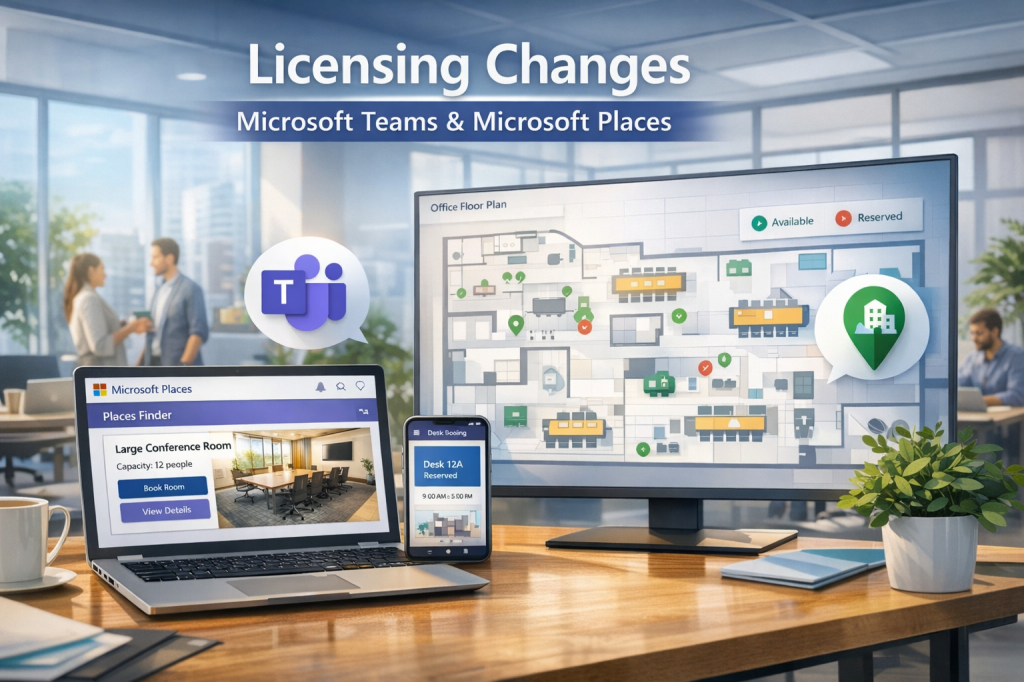
In this post I like to highlight (updated) licenses changes for Microsoft Places which might be intereseting in regards of planning and implementing and using Microsoft Places. I like to summarize what’s changing, who benefits, and what organizations should consider next.
Microsoft continues to evolve the modern workplace by expanding access to advanced collaboration, workspace management, and event capabilities. Starting April 1, 2026, licensing updates for Microsoft Teams and Microsoft Places will come into effect, enabling more organizations to benefit from AI-powered workplace coordination and scalable communication features without requiring additional premium licenses in some scenarios.
Expanded Access to Microsoft Places
The most important change is the broader availability of Microsoft Places. Previously limited in scope, AI-powered workplace coordination will be enabled for most licenses that include access to Outlook and Teams calendars, as far as I could see, such as:
- Microsoft 365 E3
- Microsoft 365 E5
- Microsoft 365 Business licenses
Organizations get access to core Microsoft Places capabilities designed to support hybrid work and smarter office utilization:
- Places Finder: Easily discover and book rooms using rich details such as images, floor plans, capacity, and available equipment.
- Places Explorer: A map-based interface that allows users to visually explore office spaces and reserve rooms directly from an interactive layout.
These features could help employees make better decisions about where and when to work, while supporting more effective use of office space across the organization.
New Teams Shared Space license
The new Teams Shared Space license replaces the former Teams Shared Devices license and is specifically designed for flexible, desk-sharing environments.
Key improvements include:
- Support for up to four desks per license: This allows more efficient scaling of shared workspace scenarios.
- Desk booking capabilities: Employees can reserve desks directly, aligning with hybrid work schedules.
- Reservation policies and usage analytics: IT and workplace teams can define booking rules and gain insights into how shared spaces are actually used.
This change makes it easier for organizations to manage hot-desking and shared offices while gaining actionable data for workspace optimization.
Teams Town Halls and Webinars
Another bigger enhancement affects Teams Town Halls and Webinars for Enterprise customers. All Enterprise users will receive premium event features for:
- Interactive events with up to 3,000 participants
- View-only streaming for up to 10,000 attendees
For larger scenarios, Microsoft introduces add-on participant packs, allowing events to scale up to 100,000 participants. These enhancements unlock a rich, professional event experience:
- Real-time chat and live reactions
- Advanced event insights and analytics
- Custom branding and event design
- Reliable, high-quality streaming technology
- Support for immersive 3D events, enabling more engaging virtual experiences
Teams Premium license remains
It’s important to note that Microsoft Teams Premium remains a separate add-on license. Teams Premium continues to provide advanced meeting capabilities such as:
- Intelligent meeting recap and AI-powered summaries
- Advanced meeting protection and compliance features
- Enhanced virtual appointments and personalized experiences
Conclusion, opinion and summary
So, the April 2026 changes expand basic capabilities, but Teams Premium remains relevant for organizations with advanced meeting and security requirements.
With these licensing updates, Microsoft is making some advanced workplace and event functionality available to a broader audience.
Key takeaways:
- (Some) Microsoft Places capabilities are now included in many Microsoft 365 (suite) licenses.
- Shared desk management should be simplified and become more scalable with the new Teams Shared Space license.
- Enterprise users receive more powerful town hall and webinar features without additional premium licensing.
- Still, Teams Premium continues to offer added value for advanced meeting scenarios.
For organizations going forward with hybrid work, these changes provide a solid foundation for a smarter space utilization, more engaging events, and improved employee collaboration.



 erik365.blog
Comment / Kommentar verfassen