
Microsoft announced their Dynamics 365 Cloud Contact Center with a Copilot-first approach on June 4, 2024. It is planned to become general available on July 1, 2024. In my opinion, the most interesting facts are that it should integrate generative AI to every communication channel with customers plus it does not require you to have Dynamics 365 as your CRM (customer relationship management system). Instead you can connect your preferred CRM system. To goal is to transform the service experience with the Copilot-first integration.

What are the key features for the Copilot-first Cloud Contact Center?
The Dynamics 365 Contact Center will enable customers to maximize their current investments by connecting to preferred customer relationship management systems (CRMs) or custom apps. It’s part of Microsoft’s commitment to infuse AI throughout the contact center workflow, which includes digital and voice channels, self-service, intelligent routing, agent-assisted service, and operations. This integration aims to help contact centers solve problems faster, empower agents, and reduce costs.
What is Microsoft’s own experience with its Copilot-first Cloud Contact Center?
The introduction of this system follows Microsoft’s own experience with generative AI in its Customer Service and Support (CSS) team. By migrating to Microsoft’s tools, the CSS team saw a 12 percent decrease in average handle time for chat engagements and a 13 percent decrease in agents requiring peer assistance to resolve an incident. Overall, there was a 31 percent increase in first call resolution and a 20 percent reduction in missed routes.
What’s the architecture behind?
The Dynamics 365 Contact Center is built natively on the Microsoft cloud, ensuring extensive scalability and reliability across voice and digital channels. It enables your organization to integrate existing CRM or custom apps.
What licenses are required?
This is not final, I guess, the most recent Dynamics 365 licensing guide I could find was released in March 2024. However, the March 2024 licensing guide contains a license called “Microsoft Copilot for Service” with terms like “modernizing existing contact centers with generative AI […] include access to Microsoft Copilot for Microsoft 365 […] pre-requisites follow Copilot for Microsoft 365 […]”. So, I would guess that this could be the suited license for the new Copilot-first cloud contact center based on Dynamics 365?
Please note that this subject to change at any time.
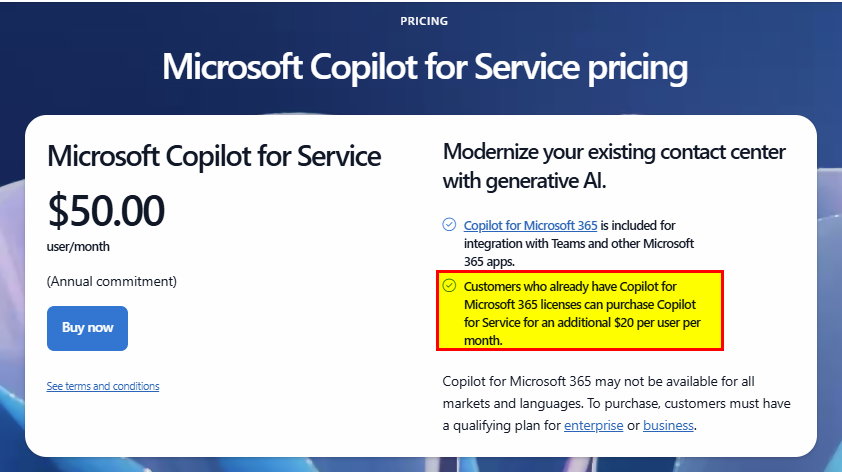
Currently, to me, it was not clear if there are additional licensing requirements, like these but I guess this is not the case because that would be Dynamics 365 …:
- Dynamics 365 Customer Service Enterprise License:
- This is required for case summarization, question answering, email drafting, and Copilot analytics features. It includes advanced AI-based customer service resources for agents and self-service for complex scenarios
- approx. $95.00 per user/month
- Customer Service Add-In License (Chat, E-Messaging, or Voice):
- Needed for composing chat responses and conversation summarization features
- The add-in licenses vary depending on the specific service:
- Digital Messaging and Voice Add-in: approx. $134.70 per user/month
- Voice Channel Add-in: approx. $112.20 per user/month
- Digital Messaging Add-in: approx. $112.20 per user/month
- Chat Add-in: approx. $89.80 per user/month
Can you integrate the Copilot-first Cloud Contact Center into Microsoft Teams as well?
As stated in the Dynamics 365 Customer Service documentation, agents can view AI-powered meeting recaps and key points of a discussion, sentiment and next steps in Microsoft Teams. However, that’s not part of the Copilot for Service as far as I can see right now.
Based on a guided tour for the Copilot for Service, it is a standalone app but you can ask Copilot for Microsoft 365, e.g. Teams Copilot Chat with Copilot for Service data, view and update CRM records in a Teams conversation and Copilot for Outlook lets you save mails and meetings to your CRM.

However, if the Dynamics 365 customer service would be used. It brings its own user interface as you can see in this video. Teams can be configured to be the related chat service behind, although there is a Dynamics 365 app for Microsoft Teams but it’s not the primary tool for an contact center agent.

Furthermore, to get voice into your Cloud Contact Center based on Dynamics 365 you can leverage the Azure Communication Services (ACS) and not the Teams Phone System. For instance, if you choose the “Omnichannel digital messaging with Dynamics 365 Customer Service and third-party PSTN”-architecture you need a carrier/provider or Azure Communication Services Direct Routing. Hence, you might could use the same session border controller (SBC) which you already use for Teams Direct Routing, in case you use Direct Routing.
Or you might want to implement the “Omnichannel digital messaging, voice, and Copilot with Dynamics 365 and Microsoft as a carrier”-architecture wherein PSTN/phone numbers are provided by Microsoft. Details for the Copilot for Service are not yet clearly documented, in my opinion.
Conclusion, opinion and summary
The announcement of “Dynamics 365 Contact Center – a Copilot-first cloud contact center” has certainly stirred up excitement for those looking forward to innovative solutions in customer service technology. It represents a step forward at Microsoft, showcasing the potential of AI and cloud-based systems to revolutionize the way businesses interact with their customers.
While it is not a native Microsoft Teams Phone solution, the enthusiasm for this new offering is available. The integration of Copilot-first technology signifies a leap forward in Microsoft’s Dynamics 365 cloud contact center platform, promising to deliver an enhanced user experience. The confidence in this system stems from its potential to revolutionize customer service interactions, providing real-time insights and personalized support.
The anticipation for the Dynamics 365 Contact Center reflects a broader trend in the industry towards AI-driven solutions, in my opinion. As organizations seek to streamline operations and improve customer satisfaction, such advancements are welcomed with open arms. The excitement is not just about what the product is now, but what it could be for the future of cloud-based customer service solutions.
So stay tuned, the general availability of this standalone Contact Center as a Service (CCaaS) solution is on July 1, 2024 which allows customers to connect to preferred customer relationship management systems (CRMs) or custom apps. For more detailed information, you can refer to the official announcement, documentation and the resources below.
Resources
- Announcing Dynamics 365 Contact Center – a Copilot-first cloud contact center to transform service experiences – The Official Microsoft Blog
- Introducing Microsoft Dynamics 365 Contact Center (youtube.com)
- Customer Service Pricing | Microsoft Dynamics 365
- Official Microsoft Copilot for Service documentation – Copilot for Service | Microsoft Learn
- Overview of Copilot for Service – Training | Microsoft Learn
- Copilot for Dynamics 365 | Microsoft Learn
- Dynamics 365 Customer Service and Dynamics 365 Field Service 2024 Release Wave 1 Release Highlights (youtube.com)
- Omnichannel digital messaging, Dynamics 365, third-party PSTN | Microsoft Learn
- Omnichannel digital messaging, voice, and copilots with Dynamics 365 and Microsoft as a carrier | Microsoft Learn
- Use direct routing to connect existing telephony service | Microsoft Learn
- Try Phone Calling – Azure Communication Services | Microsoft Learn
- Microsoft Digital Contact Center Platform | Microsoft Cloud
- Introducing the Microsoft Digital Contact Center Platform – Microsoft Dynamics 365 Blog
- Microsoft Copilot for Service public preview now available – Microsoft Community Hub
- Microsoft Digital Contact Center Platform – erik365.blog
- What is a certified Contact Center solution certified for Microsoft Teams? – erik365.blog


 erik365.blog
Comment / Kommentar verfassen